China’s Best Material Handling Solutions for Warehouses?

Time:2026-10-29 Author:Sienna
0%

China’s warehouse market offers a wide range of material handling options, from pallet trucks and conveyors to automated storage systems. The right choice depends on the work happening on the floor. A facility moving cartons by hand has different needs from one handling heavy pallets across long aisles. This guide explores the Best Material Handling Solutions For Warehouse Efficiency, with practical attention to throughput, safety, service support, and total operating cost.

Taiichi Ohno, the Toyota production-system pioneer, wrote, “Where there is no standard, there can be no kaizen.” His point applies to warehouse equipment, too: reliable results start with clear processes and consistent measures. A conveyor may speed up one station while creating a queue at the next. An automated system may reduce travel, but it still needs trained operators and dependable maintenance. Small details matter. Think of aisle width, floor condition, pallet dimensions, and the time required to replace a worn wheel or sensor. These specifics can separate a useful investment from an expensive headache.

This overview compares common solutions available from Chinese suppliers and explains what to check before choosing one. Product specifications are a starting point, not proof of real-world performance. Ask for operating data, service terms, and references from facilities with similar workloads. Not every upgrade pays off. Sometimes, a better layout or a clearer picking process helps more than another machine. That is easy to overlook, and worth questioning.
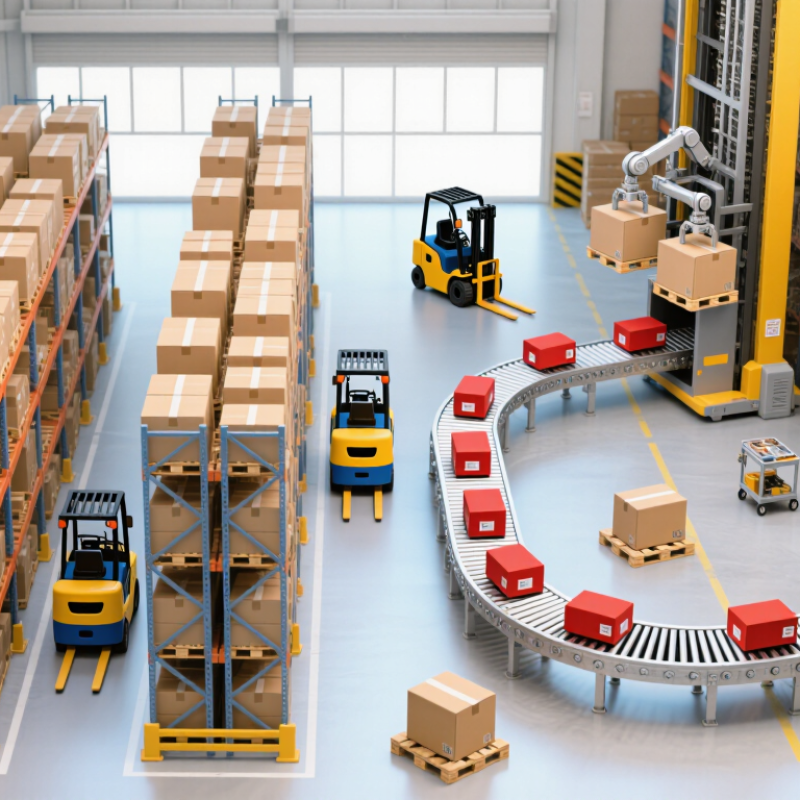
China’s Best Material Handling Solutions for Warehouses?

China Warehouse Material Handling: Core Equipment and Workflow Categories

China Warehouse Material Handling: Core Equipment and Workflow Categories

A warehouse workflow begins at the dock, not the storage rack. Pallet jacks and forklifts move inbound loads to inspection and put-away zones. Conveyors handle repeatable carton routes, while pallet racks use vertical space for reserve stock. For smaller items, bins, shelving, and guided picking carts can reduce walking between orders. Equipment choice depends on load size, travel distance, floor conditions, and peak-hour volume. A narrow aisle saves space, but leaves less room for turning and recovery when traffic builds.

Movement continues through replenishment, picking, packing, and dispatch. Reach trucks serve elevated pallet locations; order-picking equipment supports piece-level selection. Sortation systems direct parcels toward packing or shipping lanes. MHI’s 2024 Annual Industry Report found that 55% of surveyed supply-chain professionals planned to increase technology investment. That is a signal, not a guarantee that automation fits every facility. A hand-pushed cart may outperform a complex system in a low-volume zone. Measure travel time, congestion, mis-picks, and equipment downtime before changing the workflow. Small gaps matter.

At the dock, dock levelers and pallet trucks connect warehouse floors with trailers. Keep pedestrian routes visibly separate from vehicle paths, and leave clear turning space around rack ends. The International Federation of Robotics reported 541,302 industrial robots installed worldwide in 2023; this broader figure shows automation’s scale, but does not measure warehouse adoption. Start with the actual task. A scan gun, a conveyor, or a lift truck may solve a different bottleneck. Real sites are rarely tidy. The workflow needs periodic review.

Manual, Forklift, and Conveyor Systems: Match Capacity to Throughput

Choose material handling equipment by peak cartons per hour, travel distance, and load weight—not floor area alone. Manual carts suit low, irregular flows. A picker can stop at each shelf without waiting for a fixed route. But repeated long walks can quickly consume labor time. Peak hours matter.

Forklifts move palletized loads across changing routes, but aisle width, turning space, and operator training limit practical capacity. OSHA reports about 85 forklift-related fatalities and 34,900 serious injuries annually in the United States. Treat these figures as a design constraint, not a reason to avoid forklifts. Separate pedestrian paths and calculate safe cycles per hour before setting a target.

Conveyors suit steady, repeatable flows between fixed stations. Size them for peak arrivals, accumulation space, and downstream packing capacity. A fast belt only shifts the queue if packing is slower. MHI’s 2024 Annual Industry Report found that 55% of respondents planned to increase supply-chain technology investment over the next five years. That signals interest, not proof that automation pays. Compare measured throughput during a busy shift, including jams and changeovers. Averages can hide peaks. Test one aisle first, then revise the estimate.

China’s Best Material Handling Solutions for Warehouses? — Manual, Forklift, and Conveyor Systems: Match Capacity to Throughput

Compare equipment by load capacity, operating rate, travel distance, and warehouse layout. The figures below are indicative planning ranges, not guaranteed performance; actual results depend on load, route, operator, equipment, and operating conditions.

Solution Typical Rated Capacity Indicative Throughput Best-Fit Warehouse Tasks Space and Infrastructure Main Consideration
Manual pallet truck Commonly about 2,000–3,500 kg, subject to model and load conditions Distance-dependent; suited to occasional, short-distance pallet moves. There is no reliable universal moves-per-hour rate. Loading bays, short transfers, and low-volume picking areas Requires smooth, level floors and enough room to turn; no charging system required Low equipment complexity, but performance relies on physical effort and is limited over long distances.
Powered pallet truck Often about 1,500–3,000 kg; verify the equipment rating and load center Suitable for repeated pallet transfers; achievable moves per hour vary substantially with route length and waiting time. Horizontal transport between receiving, storage, and dispatch Needs clear travel lanes, charging access, and a floor appropriate for the truck and load Reduces pushing effort, but generally does not replace a lift truck for high-level racking.
Counterbalance forklift Common warehouse models are often rated around 1,500–5,000 kg at a specified load center Can support repeated pallet handling; practical cycles per hour depend on lift height, travel distance, traffic, and attachment use. Dock work, pallet stacking, loading vehicles, and moving heavier loads Requires suitably wide, marked aisles, adequate floor capacity, and a charging or refueling plan Rated capacity can fall as lift height or load center increases; check the capacity plate and operating conditions.
Reach truck Often around 1,000–2,500 kg, with capacity varying by lift height and configuration Designed for repetitive storage and retrieval; actual pallet moves per hour are site- and task-dependent. Pallet storage in taller racking and narrower aisles than many counterbalance-truck layouts Needs smooth floors, suitable racking, and aisles designed to the truck’s turning requirements Useful for increasing storage density, but not typically intended for outdoor or rough-surface work.
Carton or tote conveyor Specified by the load’s dimensions and weight per item, not by pallet capacity Configured systems may handle hundreds to several thousand items per hour; the usable rate depends on line speed, spacing, merges, and downstream processing. Predictable movement of cartons or totes between picking, packing, sorting, and dispatch Requires a planned route, power, guarding, controls, and access for maintenance Best suited to steady, repeatable flows; changes to layout or product mix may require system modifications.
Pallet conveyor Set by the system design, pallet type, and load; confirm the maximum unit load with the supplier. Usually specified in pallets per hour for a defined layout; accumulation, transfers, and controls affect the rate. Fixed pallet routes linking production, storage, and shipping areas Needs floor space, power, controls, safety guarding, and a compatible pallet footprint Can reduce repeated vehicle travel on stable routes, but is less flexible than mobile equipment.
Selection rule: Match the equipment to the peak hourly flow and the unit being moved. Use rated load capacity for safe load selection, and validate throughput with the actual route, lift height, shift pattern, and bottlenecks. Carton or tote rates and pallet-move rates are different measures and should not be compared directly.

AS/RS and High-Bay Storage: Compare Density, Access, and Investment

AS/RS can use tall racks, narrow aisles, and automated cranes or shuttles to store more pallets in a limited footprint. That density matters when floor space is costly or expansion is difficult. Very compact. But high density can make access depend on equipment availability and software coordination. A stalled crane may delay several retrievals, so maintenance plans and recovery procedures deserve attention.

High-bay storage also uses vertical space, but it can range from manually operated systems to automated installations. Its access pattern depends on the design: pallet locations may be straightforward to reach, or retrieval may rely on specialized equipment. For warehouses handling many different SKUs, compare retrieval frequency and order profiles, not just the number of pallet positions. A full rack is not automatically an efficient rack.

Investment varies with building height, floor conditions, fire protection, controls, and labor needs. AS/RS often requires greater upfront spending and careful integration with warehouse software. High-bay systems may offer a simpler step up, though labor and equipment costs can accumulate over time. Model peak-hour demand, not only average daily volume. Also test a realistic disruption scenario; estimates often look cleaner than operations do.

AMRs and AGVs: Logistics Robot Sales Rose 44% to 113,000 in 2022

China’s logistics robot market expanded quickly in 2022. GGII’s 2023 China Mobile Robot (AGV/AMR) Industry Research Report estimates sales reached 113,000 units, up 44% year over year. The figure reflects rising adoption of automated transport in warehouses and factories. It is a useful signal, not a guarantee. Sales totals do not show how many robots were deployed successfully, or how much labor and travel time they saved.

For warehouse operators, AMRs can navigate changing routes, while AGVs typically follow more defined paths. Both can move totes, pallets, or replenishment stock between storage, picking, and packing areas. Picture a narrow aisle where a robot pauses as a worker crosses; safe handoffs and reliable traffic management matter as much as speed. Before buying, facilities should map floor conditions, peak-hour traffic, load sizes, and integration needs. Measure completed moves per shift, downtime, and maintenance costs after deployment. A high unit count can encourage unrealistic expectations. Some warehouses may still find manual carts more practical in low-volume zones. The right solution depends on the work, not the headline.

China’s Logistics Robot Sales: AMRs and AGVs

Annual sales rose 44% to 113,000 units in 2022.

The 2021 figure is approximately 78,500 units, calculated from the reported 2022 sales total and 44% year-over-year increase.

Safety and ROI: OSHA Reports About 85 U.S. Forklift Deaths Annually

China’s Best Material Handling Solutions for Warehouses?

OSHA has cited an estimate of about 85 forklift-related deaths in the United States each year. Treat that figure as a serious warning, not a fixed annual count; reported totals can vary by source and period. For warehouse managers, each incident represents a worker, a family, and a preventable risk.

A safer layout starts with clear separation between forklifts and pedestrians. Marked walkways, visible crossings, working warning lights, and unobstructed sightlines help reduce close calls. Keep loads low while moving, inspect vehicles before shifts, and train operators to slow down near blind corners. Small details matter: a pallet left across a turning path can change a routine trip into a collision. No layout is perfect.

Safety can also support return on investment. Fewer collisions mean less equipment damage, downtime, and disruption to orders. Select handling equipment to match aisle width, load weight, and travel distance, rather than choosing by purchase price alone.

Track near misses, maintenance, and training completion alongside productivity. These records can reveal weak spots before injuries occur. The uncomfortable part is that safety improvements may slow traffic at first. That deserves review, not dismissal: a faster workflow is not a better one if workers face greater risk.

FAQS

How does AS/RS increase warehouse storage density?

It uses tall racks, narrow aisles, and automated cranes or shuttles. This can store more pallets within a limited floor area. Very compact.

Is high-bay storage always more efficient than standard storage?

No. It uses vertical space, but efficiency depends on access, equipment, and order patterns. A full rack is not automatically an efficient rack.

What should warehouses compare before choosing AS/RS or high-bay storage?

Compare retrieval frequency, SKU variety, peak-hour demand, and labor needs. Also check building height, floor conditions, fire protection, and software integration.

Why can AS/RS require a larger investment?

It may need costly equipment, controls, and careful software integration. A stalled crane can delay several retrievals, so recovery plans matter.

Can high-bay storage cost less over time?

It may offer a simpler upgrade, but labor and equipment costs can accumulate. The actual cost depends on the installation and daily workload.

What did logistics robot sales indicate in 2022?

Estimated sales in China reached 113,000 units, up 44% from 2021. That signals adoption, not guaranteed savings or successful deployments.

How do AMRs and AGVs differ in warehouse use?

AMRs can navigate changing routes, while AGVs usually follow more defined paths. Both can move totes, pallets, or replenishment stock.

What should a warehouse measure after deploying transport robots?

Track completed moves per shift, downtime, and maintenance costs. Map narrow aisles, floor conditions, and peak traffic first. Speed alone tells an incomplete story.

Conclusion

Choosing the Best Material Handling Solutions For Warehouse Efficiency begins with understanding the flow of goods, order volume, available space, and labor needs. Manual equipment can suit lighter workloads and flexible tasks, while forklifts and conveyors support heavier loads and more consistent throughput. Automated storage and retrieval systems and high-bay storage can increase storage density, but their access speed, operational complexity, and investment requirements should be weighed against a warehouse’s actual needs.

Autonomous mobile robots and automated guided vehicles offer another way to move materials, and reported logistics robot sales rose 44% to 113,000 units in 2022. Yet technology alone does not guarantee a strong return: equipment should fit existing workflows and be evaluated for productivity, maintenance, and safety. Safe operating procedures, worker training, and suitable equipment selection are essential, especially given reports of about 85 forklift-related deaths annually in the United States. A balanced approach can improve efficiency while helping protect workers and control costs.

Sienna

Sienna

Sienna is a skilled marketing professional with a deep expertise in our company’s core products and services. With a passion for innovation and detail, she plays a pivotal role in crafting insightful blog posts that not only highlight the unique features of our offerings but also provide valuable......