China’s warehouse sector is entering a practical period of change. Rising e-commerce volumes, tighter delivery windows, and higher labor costs are reshaping storage decisions. Distribution centers now need more than additional floor space. They need speed, visibility, safety, and flexibility.
This article examines the China Top 10 Future Trends in Warehouse Storage Systems. It explores automated storage and retrieval systems, warehouse robotics, artificial intelligence, digital twins, cloud platforms, and energy-efficient designs. It also considers modular racking, goods-to-person picking, machine vision, and integrated warehouse management software. Each trend affects daily operations differently. A mobile robot may shorten travel distances, while better slotting can improve output without major construction. Small details matter.
Real warehouses rarely follow a perfect technology roadmap. Some facilities still depend on paper records, manual inspections, or aging racks. That is not failure. It shows why practical planning remains essential. Companies must evaluate product types, order profiles, building height, worker training, maintenance access, and investment limits before choosing a system. The most advanced solution may not be the most suitable one.
Reliable progress requires evidence from operating sites, equipment suppliers, safety professionals, and warehouse managers. This overview uses that practical perspective to discuss Future Trends In Warehouse Storage Systems. It aims to support informed decisions, not promote automation for its own sake. Conditions change. Assumptions should be tested. A flexible warehouse can keep improving when technology, demand, and business priorities shift.
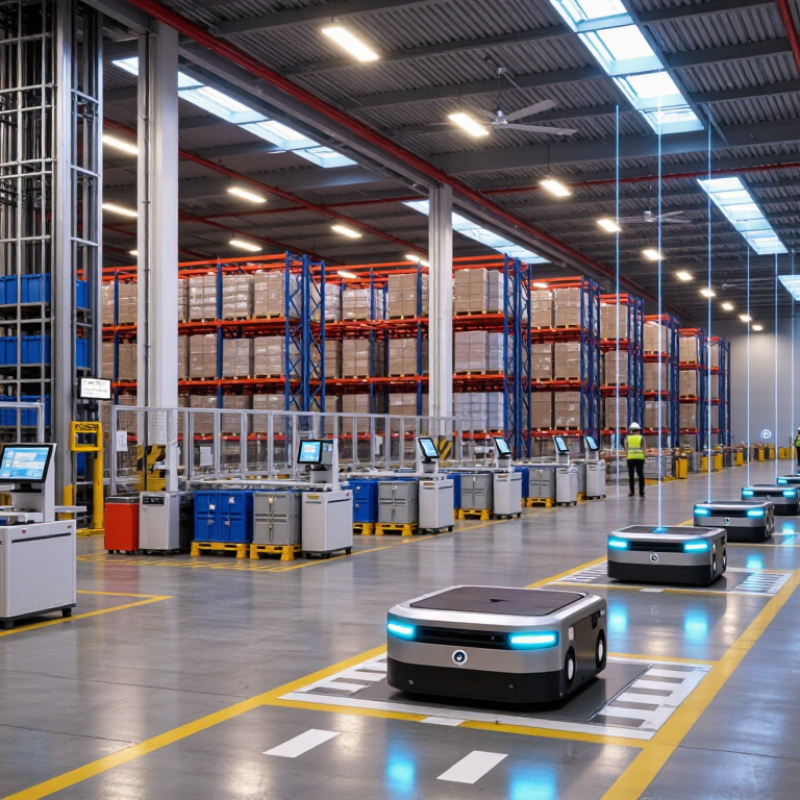
China’s reported 140.2 billion parcels reveal intense pressure on storage and fulfillment networks. The ¥15.42 trillion online retail market adds another demand signal. More orders mean faster picking, tighter inventory control, and shorter delivery windows. Warehouse managers now examine every meter of floor space. Small delays become expensive during peak shopping periods.
Future systems will combine automated storage, shuttle equipment, mobile robots, and intelligent warehouse software. Goods-to-person designs can reduce walking and improve picking consistency. High-density storage may help sites handle rising volumes without immediate expansion. Sensors can monitor stock locations, equipment conditions, and temperature changes. Useful data, however, depends on accurate scanning and disciplined operating procedures.
Not every facility needs maximum automation. Capital costs, maintenance skills, building height, and product variety must guide each decision. Some warehouses still perform better with simple shelving and carefully designed workflows. Forecasts can be wrong. I have seen efficiency projects focus on machines while ignoring replenishment rules and worker training. That mistake can create congestion instead of speed. Flexible systems, modular layouts, and regular performance reviews may prove more valuable than impressive hardware alone. Safety checks must remain practical, visible, and consistent during daily operations.
China’s warehouse storage systems are moving toward robotic automation at a practical scale. Autonomous mobile robots can carry bins across changing routes, while automated storage and retrieval systems use vertical space more efficiently. Goods-to-person stations bring inventory directly to workers, reducing long walking distances and repeated lifting.
A well-designed site may combine all three technologies. For example, an AMR can collect a tote from a receiving zone, transfer it to an AS/RS unit, and deliver it to a picking station. Sensors, barcode checks, and warehouse software must coordinate every movement. Small details matter. A blocked charging point can delay dozens of tasks. Poor slotting can also make fast robots look slow.
The best results come from measured deployment, not dramatic replacement. Start with clear data on order volume, item dimensions, storage density, and peak periods. Then test one process under real operating conditions. It may reveal unexpected issues. Dust can affect sensors. Workers may need more time to adapt than planners expect. Maintenance access is often underestimated.
Reliable systems also require human oversight, emergency procedures, and regular performance reviews. Automation should improve accuracy and safety without creating isolated equipment that cannot communicate. In China’s future warehouses, flexible layouts and interoperable controls will matter as much as robot speed.
China’s warehouse storage systems are moving toward intelligent control, driven by AI, digital twins, and tighter cost management. The 14.1% logistics cost ratio is a useful reference point for evaluating this shift. It shows why storage decisions must connect labor, space, energy, and delivery performance.
AI can forecast inbound volumes, identify slow-moving inventory, and adjust slotting rules before congestion appears. Digital twins create a live virtual model of racks, conveyors, robots, and order flows. Managers can test a layout change without stopping operations. A practical dashboard may display bin occupancy, picking distance, equipment faults, and hourly energy use. Small details matter.
Real warehouses remain less predictable than simulations. Product packaging changes. Staff need training. Sensors sometimes produce incomplete data. This is where professional review becomes essential. Engineers should compare AI recommendations with cycle counts, maintenance records, and worker feedback. Automation can reduce repetitive decisions, but it cannot remove operational judgment. A warehouse may look intelligent while carrying inaccurate inventory. That is a costly weakness. Better systems use controlled pilots, clear data ownership, and measurable targets, such as fewer replenishment trips, lower error rates, and improved space utilization. Progress may be uneven. That is normal.
| Rank | Future Trend | Core Technology or Practice | Verified Data Point or Standard | Warehouse Application | Expected Business Value | Priority |
|---|---|---|---|---|---|---|
| 1 | AI-Driven Intelligent Control | Machine learning, demand forecasting, slotting optimization, and dynamic order sequencing | China’s total social logistics costs were equivalent to approximately 14.1% of GDP in 2024. | Use AI to reduce unnecessary travel, improve replenishment timing, balance storage capacity, and support labor planning. | Lower handling costs, fewer stockouts, better labor utilization, and faster response to demand changes. | Very High |
| 2 | Warehouse Digital Twins | Real-time 3D models connected to WMS, WES, sensors, and equipment data | A digital twin synchronizes physical assets, inventory, orders, and operating conditions through continuously updated data. | Simulate layout changes, storage-density improvements, equipment failures, throughput bottlenecks, and peak-season scenarios before implementation. | Reduces project risk and supports data-based decisions for capacity expansion and process redesign. | Very High |
| 3 | High-Density Automated Storage and Retrieval | Automated storage and retrieval systems, shuttle systems, stacker cranes, and goods-to-person stations | The standard pallet footprint commonly used in China is 1,200 mm × 1,000 mm under GB/T 2934. | Design storage locations, aisles, conveyors, and robotic interfaces around standardized unit loads and pallet dimensions. | Improves cubic-space utilization, inventory accuracy, and order consistency while reducing manual travel. | Very High |
| 4 | Autonomous Mobile Robots | AMRs, autonomous forklifts, fleet-management software, and collaborative picking systems | AMRs operate through onboard navigation, mapping, obstacle detection, and fleet-level task allocation rather than fixed tracks alone. | Automate pallet movement, tote delivery, picking assistance, replenishment, and reverse logistics. | Provides scalable automation with less fixed infrastructure and easier adaptation to changing warehouse layouts. | High |
| 5 | IoT-Based Inventory Visibility | RFID, barcode scanning, location sensors, machine vision, and environmental monitoring | GS1 identification and barcode standards enable globally structured identification of products, logistics units, and locations. | Track stock, pallets, bins, equipment, temperature, humidity, and location events throughout the warehouse. | Improves inventory accuracy, traceability, cycle counting, and exception management. | High |
| 6 | Real-Time WMS and WES Integration | Cloud or hybrid WMS, warehouse execution systems, API integration, and event-driven data exchange | WMS manages inventory and warehouse transactions, while WES coordinates real-time work priorities and automation resources. | Connect receiving, put-away, picking, packing, dispatch, labor, and automated equipment within one operating-control layer. | Creates end-to-end process visibility and improves throughput during variable order volumes. | High |
| 7 | Green and Low-Carbon Warehousing | Rooftop solar, LED lighting, energy-management systems, efficient refrigeration, and electric material-handling equipment | China’s national targets call for carbon peaking before 2030 and carbon neutrality before 2060. | Measure electricity by process, optimize HVAC and refrigeration, reduce idle energy use, and increase renewable-energy consumption. | Reduces operating expenditure, carbon emissions, and exposure to future energy and environmental requirements. | High |
| 8 | Cold-Chain Intelligence | Temperature sensors, connected refrigeration, automated alerts, and condition-based maintenance | Frozen food storage and transport are generally controlled at or below −18°C under applicable food-safety requirements. | Monitor temperature continuously, record deviations, and trigger corrective actions for frozen, chilled, pharmaceutical, and sensitive goods. | Protects product quality, improves compliance records, and reduces spoilage and avoidable losses. | High |
| 9 | Flexible Modular Warehouse Design | Configurable racking, movable workstations, modular conveyors, and scalable automation cells | Modular systems allow capacity and process resources to be expanded in stages instead of requiring a single fixed-capacity build. | Support multi-channel fulfillment, seasonal peaks, SKU growth, returns processing, and mixed pallet-and-piece picking. | Improves asset flexibility and lowers the risk of overbuilding for uncertain future demand. | Medium to High |
| 10 | Safety-Centered Human–Machine Collaboration | Safety scanners, access control, machine guarding, wearable alerts, training analytics, and risk monitoring | ISO 45001 provides a recognized framework for occupational health and safety management systems. | Separate pedestrian and vehicle zones, monitor restricted areas, standardize emergency procedures, and manage automated-equipment risks. | Reduces accident exposure, supports regulatory compliance, and improves reliability in increasingly automated facilities. | High |
China’s warehouse future is becoming connected infrastructure. The Ministry of Industry and Information Technology reported 3.38 million 5G base stations by the end of 2023. This network supports low-latency communication between scanners, cameras, sensors, and automated vehicles.
A connected warehouse can track pallet movement almost in real time. Temperature sensors can flag a cold-storage problem before products spoil. Cameras can identify blocked aisles, while positioning tags guide workers around loading zones. GSMA Intelligence expects China’s Internet of Things connections to exceed five billion by 2030, creating a larger data foundation for logistics operations.
The practical challenge is not connectivity alone. It is data quality. A dusty sensor, weak indoor signal, or badly mapped shelf can produce confident but wrong instructions. My field observation is simple: warehouses often automate visible tasks before fixing inconsistent inventory records. That choice creates expensive confusion. Operators should test 5G coverage at rack level, audit sensor accuracy, and keep manual controls for exceptions. Not perfect yet. Better systems learn from these failures.
China’s future warehouse storage systems will be shaped by greener, more resilient cold chains. Temperature-controlled warehouses consume substantial electricity, especially during summer peaks. Better insulation, rapid doors, and variable-speed refrigeration can reduce avoidable losses. Small changes matter.
Renewable energy is becoming practical on warehouse rooftops. Solar panels can support daytime cooling, while batteries manage evening demand. Heat recovery systems may warm offices or water instead of releasing useful energy.
Digital sensors should record temperature, humidity, power use, and equipment faults continuously. These records help managers verify performance rather than trust estimates. Independent energy audits and regular calibration also improve reliability.
However, green storage is not automatically sustainable. Solar output changes with weather, and batteries remain expensive. Older facilities may lack suitable roofs or reliable grid connections.
Refrigeration upgrades can also create construction waste and embodied emissions. This is where China’s 2060 net-zero goal requires more than new equipment. Warehouse owners should measure whole-life carbon, train maintenance teams, and plan backup power for extreme heat or grid disruption.
Cold-chain data must remain accurate during software failures. That part is often overlooked.
A resilient system may cost more initially, yet spoiled food, medicine, and business interruptions can cost far more. Progress will be uneven, and some planned solutions will need revision after real operating seasons.
High parcel volumes and online retail growth create tighter picking, storage, and delivery demands. Small delays become costly during peak periods.
Automated storage, shuttle equipment, mobile robots, and warehouse software may work together. Goods-to-person systems can reduce walking and improve picking consistency.
No. Building height, product variety, maintenance skills, and investment limits should guide decisions. Simple shelving may work better.
High-density storage can increase capacity without immediate expansion. Managers should examine each floor section, aisle width, and replenishment route.
Machines cannot fix unclear replenishment rules or weak worker training. Congestion may increase. That risk deserves honest review.
Better insulation, rapid doors, and variable-speed refrigeration can reduce avoidable electricity losses. Small changes matter.
Rooftop solar can support daytime cooling, while batteries may manage evening demand. Heat recovery can warm offices or water.
Sensors should track temperature, humidity, power use, stock locations, and equipment faults. Accurate scanning remains essential.
No. Solar output changes, batteries cost money, and older buildings may need major upgrades. Whole-life carbon matters.
They should plan backup power, calibrate sensors, audit energy use, and train maintenance teams. Software failures still happen.
China’s warehouse storage sector is entering a period of rapid transformation, driven by 140.2 billion parcels and online retail sales reaching ¥15.42 trillion. These demands are accelerating the adoption of robotic automation, including autonomous mobile robots, automated storage and retrieval systems, and goods-to-person solutions. Together, these technologies can improve storage density, order accuracy, throughput, and labor efficiency while supporting more flexible warehouse operations.
The Future Trends In Warehouse Storage Systems will also center on intelligent control and connected infrastructure. Artificial intelligence, digital twins, and real-time data analysis can help reduce waste and improve logistics performance, while 5G networks and IoT devices enable seamless communication between equipment, inventory, and management platforms. At the same time, resilient cold-chain capabilities, renewable energy, and energy-efficient facilities will become increasingly important as China advances toward its 2060 net-zero goal.

TKS Logistics